


CARACAS, Feb 4 — The landscape is quickly shifting in Venezuela without deposed leader Nicolas Maduro at the helm.
In the month since a deadly US military operation toppled the long-term president, interim leader Delcy Rodriguez has fallen in line with many of Washington’s demands while still supporting leftist Chavista rhetoric.
This is what has changed for Venezuela:
Trump ties
Unlike the invasion of Iraq, Washington avoided a total break in continuity of leadership after US special forces captured Maduro, opting instead to allow the country’s vice president to assume power.
Trump has since said he has been working “really well” with Rodriguez, and the Venezuelan interim leader is expected to visit the United States.
The countries have moved to rekindle diplomatic relations, which were severed in 2019 under Maduro.
But Trump has also warned Rodriguez she could face a fate similar to Maduro’s if she fails to action US demands on policy reforms and access to oil.
Venezuela’s interim President Delcy Rodriguez speaks with the new head of the United States diplomatic mission for Venezuela Laura Dogu during a meeting at the Miraflores Presidential Palace in Caracas on February 2, 2026. — AFP pic
Oil reforms
Rodriguez’s interim government swiftly approved reforms to the oil industry, in what analysts have described as a law heavily influenced by Washington.
Private companies can now operate independently in the sector, instead of only as minority partners in joint ventures with the state oil company.
The new regulations also lower royalty payments and relinquish state control of exploration.
“This is the only way to obtain significant investments,” said US-based Latin America energy analyst Francisco Monaldi.
Trump has also urged US oil giants to invest in the country – though some remain wary, citing political instability and massive costs in reviving the sector that has been marred by years of corruption and US sanctions.
In the meantime, the US government has directly seized and sold some Venezuelan oil.
Balancing act
On paper, Rodriguez, previously the vice president, is leading an interim administration of Maduro’s government.
But in reality, she’s introduced serious changes, including swapping out some ministers and high-ranking military officials.
Key players, like Interior Minister Diosdado Cabello and Defense Minister Vladimir Padrino, have remained in place.
“This is a phase of readjustment,” said Guillermo Tell Aveledo, a professor at Metropolitan University in Caracas.
US rapprochement, which has included talks between Rodriguez and US chief of mission Laura Dogu on the country’s “transition” comes as the government also continues to organize protests demanding Maduro’s release.
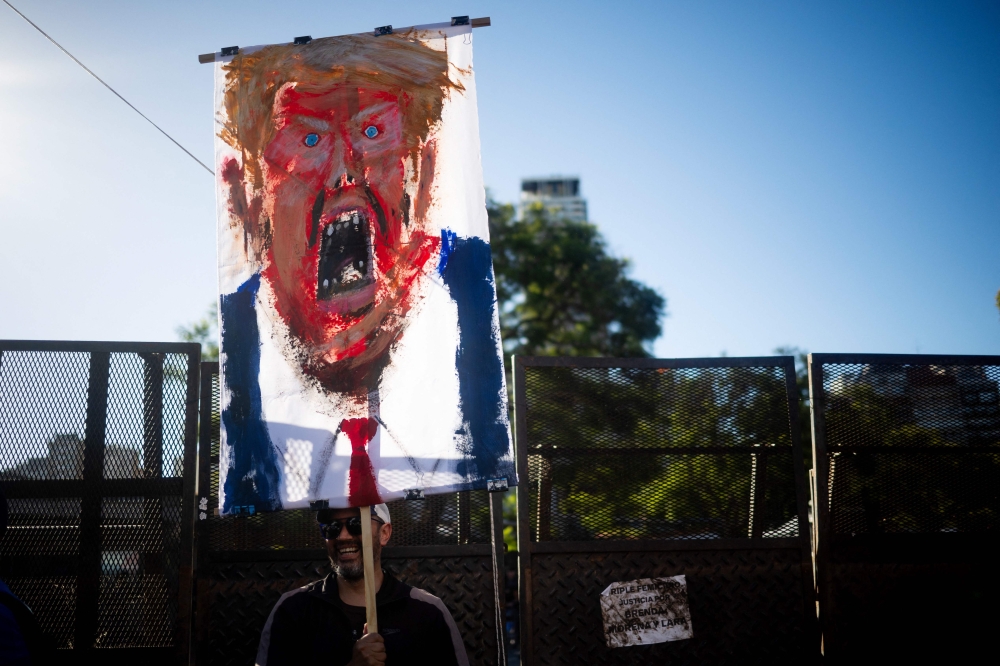
A man holds a painting of US President Donald Trump during a protest against the US intervention in Venezuela in Buenos Aires on January 5, 2026. — AFP pic
Amnesty and fear
Rodriguez has also announced a general amnesty, which is expected to be adopted by the national assembly this week.
Its scope is unclear, though NGO Foro Penal says about 700 political prisoners remain behind bars, even as some have already been freed since Maduro’s ouster.
The interim president has also announced the closure of the infamous Helicoide prison, where the government has been accused of torturing dissidents.
“The amnesty is more about forgetting than forgiving,” said Alfredo Romero, Foro Penal’s director, who called for an end to government impunity.
The fear around political activism has diminished, but hasn’t completely disappeared for ordinary Venezuelans who still offer their criticisms in hushed tones. There is a “tactical liberalisation,” Aveledo said.
“The system is recalibrating the cost of repression.” — AFP


