

- Mexican drug lord’s death didn’t disrupt his Jalisco cartel’s powerful US networks
- Cartel launders money, buys guns, and smuggles fuel inside US
- After raid, calls grow in Mexico for US to step up drug fight at home
MEXICO CITY, March 2 — The Mexican government’s killing of one of the world’s biggest kingpins, known as “El Mencho,” is being heralded as a major blow to drug trafficking. But it did little to dismantle his cartel’s critical US operations, which will continue fuelling its dominance unless Washington steps up the fight inside its own territory, US and Mexican security sources said.
Mexican special forces killed the elusive drug lord Nemesio Oseguera in a US-backed raid on February 22. It was the biggest takedown of a cartel kingpin in at least a decade.
El Mencho’s Jalisco New Generation Cartel responded by torching buildings and blockading roads across Mexico in a terrifying display of its territorial reach that grabbed headlines worldwide. On the US side of the border, the cartel also has extensive networks that receive far less attention yet are the lifeblood of its power and profits, current and former US and Mexican officials said. These enable it to source military-grade weapons, smuggle billions of dollars’ worth of fuel, and launder billions more in cartel cash.
“The United States has become increasingly important to cartels, especially the Jalisco New Generation Cartel, for it to thrive,” said Alamdar Hamdani, the former US attorney for the Southern District of Texas.
White House spokeswoman Anna Kelly said that the Trump administration “has worked closely with the Mexican government to stop the scourge of drugs and criminals entering our country” and that this cooperation led to the “elimination of infamous narcoterrorist ‘El Mencho.’” “The president will continue to do everything in his power to keep America safe from these vicious criminals and the drugs they use to poison our country,” she added.
A bullet-riddled facade with the acronym of the Jalisco New Generation Cartel (CJNG) is pictured at an area where the Jalisco New Generation Cartel (CJNG) and local drug gangs are fighting to control the territory, in El Aguaje, Michoacan state, Mexico April 23, 2021. — Reuters pic
Mexicans calling for US to take more action at home
Washington heaped pressure on Mexico to step up the cartel fight ahead of the raid against the once untouchable drug lord. Such actions are risky for the Mexican government because they can spark a wave of violence in a country where the drug war has already cost tens of thousands of lives.
The decision by Mexican President Claudia Sheinbaum to escalate her crackdown has prompted renewed calls for the US to do more on its side of the border.
“The United States can’t turn a blind eye to Mexico’s demands any longer,” said Mexican Congressman Alfonso Ramirez Cuellar, a close ally of Sheinbaum.
He said the US needed to improve efforts to go after money laundering, fuel smuggling and, above all, weapons smuggled from the US into Mexico.
“We can’t stop drug traffickers if the United States continues allowing them to strengthen their military capabilities,” he said.
The US has built and prosecuted hundreds of cases related to cartel-related activity inside the US in recent years. But the Trump administration last year diverted thousands of agents, including many specialising in drugs, firearms, and money laundering, away from such cases and to the mass deportation effort. Reuters also reported in September that the number of people charged with drug conspiracies and money laundering fell significantly last year. “The Trump administration has predominantly focused on highly militarised actions against drugs abroad and has not paid similar attention to actions at home,” said Vanda Felbab-Brown, a security expert. A spokesperson from the US Department of Justice said the administration was “acutely focused on securing the border, prosecuting violent traffickers, deporting any and all members of cartel networks and ensuring they are held accountable for their horrific crimes against the American people.”
The department also pointed to a string of recent cases, including against high-ranking members of the Jalisco cartel. The office of Mexico’s president did not respond to requests for comment.
Roberto Velasco, the Undersecretary for North America at Mexico’s Foreign Ministry, said the Mexican government has repeatedly emphasised in bilateral meetings and working groups that stopping arms trafficking is a top Mexican priority.
“While there has been some significant progress, we believe much more can be done to control this flow and to target the networks in the United States that facilitate it, empowering transnational criminal organisations,” he said.
Reuters spoke to a dozen current and former US and Mexican officials after El Mencho’s killing and reviewed US court documents from 10 recent cases related to the cartel to gain better insight into its US operations.
What emerged was a picture of US-based activities that are critical to the cartel’s firepower and profits and unlikely to be impacted by the death of its leader. Reuters reporting also revealed how US companies and professionals — from fuel traders to cell phone retailers to stockbrokers — are complicit in cartel activity.
“There’s a lot of economic integration — both legal and illegal,” said Alexia Bautista, a former Mexican diplomat.
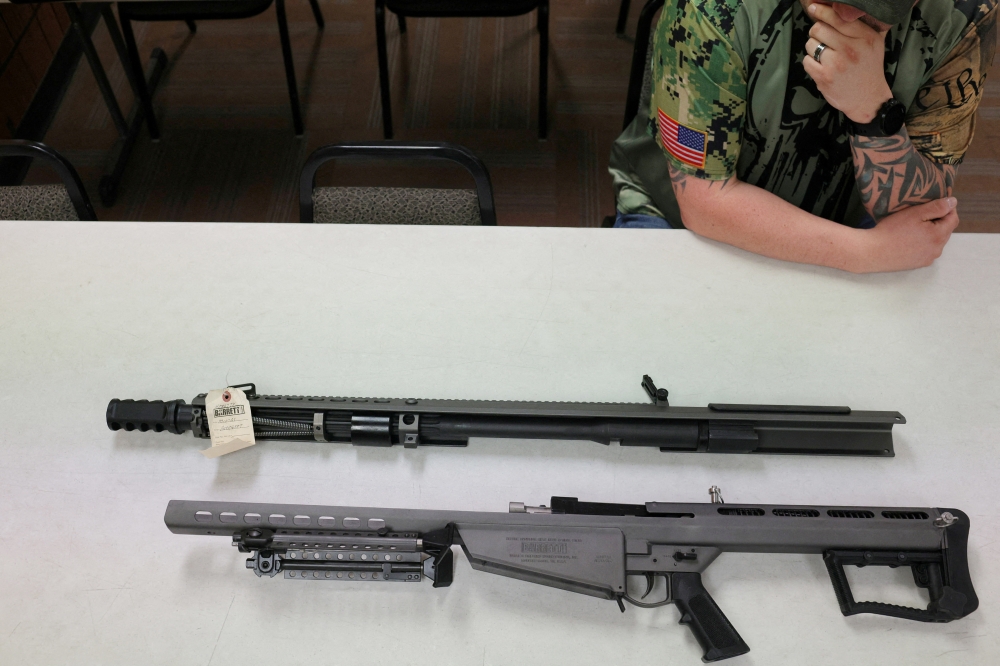
An employee shows a .50‑caliber Barrett M107A1 semi‑automatic rifle to Reuters at a gun store after US officials accused members of the Cobian family of purchasing, and recruiting others to purchase .50‑caliber Barrett sniper rifles that were then smuggled to the Jalisco New Generation Cartel (CJNG) in Mexico, in Racine, Wisconsin June 26, 2023. — Reuters pic
Cartels fight the Mexican military with US weapons
When Mexican Special Forces descended on a cabin in a picturesque mountain town where El Mencho was waiting for a visit from his girlfriend, the cartel leader’s men fought back — armed predominantly with US weapons, Mexican Army chief Ricardo Trevilla said at a press conference.
Some 80 per cent of the 23,000 weapons the Mexican government has seized since Sheinbaum took office in late 2024 came from the US, he added.
The Jalisco cartel, in particular, has become adept at sourcing heavy, military-grade artillery from US gun shops across the country, according to US and Mexican authorities. Through one of its gun-running networks, the cartel obtained guns from more than a dozen US states, including .50 calibre rifles capable of downing helicopters and FN SCAR assault rifles designed for US Special Forces, according to a Reuters investigation.
While such firepower can be purchased legally in the US, the arms become illegal once they enter Mexico, which has tight gun regulations.
“We complain about the Mexicans’ lack of effort to go after the drugs down there, but then why does the US dismiss their argument that we could do better on the guns going southbound?” said Derek Maltz, former acting administrator for the US Drug Enforcement Administration.
“The US has to step up in a lot of areas,” he said, citing not only arms trafficking prosecutions but also public health and mental illness programmes to curb American drug demand.
Fuel smuggling powers the Jalisco Cartel
Americans’ insatiable demand for narcotics has long fuelled the cartels’ profits. But while drugs are the cash cow, in less than a decade the groups have quietly built a multi-billion dollar cross-border petroleum empire. The Jalisco cartel dominates this business, which would have been impossible to expand without a network of knowingly or unknowingly complicit US companies that includes refiners, fuel traders, transport companies and storage facilities, as Reuters reported in October. “This is no longer stealing fuel from (state energy company) Pemex,” said Guadalupe Correa, a professor at George Mason University who has studied how cartels diversify their income streams. “It’s a huge, transnational business.”
The cartel orchestrates two versions of the scheme, according to US and Mexican authorities.
In Mexico, cartel members steal crude oil from Pemex that is then smuggled across the border where it gets sold to US companies. In the other direction, cartel members purchase mostly diesel and gasoline from US companies via shell companies. The fuel arrives in Mexico disguised as something else, in what boils down to a very lucrative tax fraud. Sheinbaum confirmed last year that US business people had been involved in the fuel smuggling cases under investigation. “One cannot explain otherwise how fuel comes from the US to Mexico, and enters illegally,” she said.
Hundreds of millions in cartel-related assets in US
In late 2024, El Mencho’s son-in-law Cristian Gutierrez Ochoa was arrested in a US$1.2 million (RM4.6 million) house in Riverside, California.
According to the court records, Gutierrez, who pled guilty to an international money laundering conspiracy in June 2025, said he bought the five-bedroom property using drug proceeds funnelled through a Mexico-based shell company set up to look like a tequila producer.
Real estate is one of myriad ways Jalisco cartel cleans its cash in the US
In many of the schemes, the involvement of US businesses is key, said Carlos Olivo, a former DEA agent who specialised in tracing the cartel’s US financial networks. He said the cartel’s money flows through restaurants, textiles, the music industry, the agricultural sector and even the US stock market.
“In total, we’re talking about hundreds of millions in assets in cartel-related money in the United States,” he said.
In response to questions about this story, a DEA spokesperson said the cartels employed a wide range of money laundering schemes and “also use trade-based money laundering schemes, cryptocurrency, bulk cash, and Chinese underground banking systems to fund their operations.”
Alejandro Celorio, a former Mexican diplomat, said he hoped that Sheinbaum’s decision to go after the most powerful cartel leader in the country would inspire the US to redouble its efforts — inside its own borders.
“As the world’s leading commercial and military power, the US could certainly investigate more deeply how money and drugs move within US territory,” Celorio said. — Reuters


