


- Trump administration using video game and other memes to sell Iran war
- Public relations campaign aimed mainly at young men, experts say
- Critics say it demeans the victims of war
- PR campaign comes as administration offers changing rationales for the war
WASHINGTON, March 7 — The White House video begins with a scene from Call of Duty, the action-packed, first-person shooter game.
It then quickly cuts to images of fighter jets launching from an aircraft carrier, missiles streaking through the sky and targets exploding in slow motion – all set to the pounding beat of rapper Childish Gambino’s song Bonfire and a deep-voiced narrator declaring, “We’re winning this fight.”
A Call of Duty kill score, which shows the numerical value earned for eliminating enemies, appears after each explosion. Viewed over 58 million times, the video is part of a social media campaign the Trump administration has launched to sell its bombing campaign against Iran to the American public.
The sober charts and briefings that defined past conflicts have largely been replaced by a public relations campaign designed with a video-game vibe showcasing the technological might and lethality of the US military, with stealth aircraft slicing through clouds and targets exploding in Hollywood-like fashion as fireballs fill the screen to music.
Whereas past administrations often used public relations campaigns early in a conflict to explain why the US has gone to war, this time around it’s about how the US has gone to war – with an on-brand air of bravado.
Released by the White House and the Pentagon on X, TikTok and Instagram and packed with pop culture references, pulse- pounding music, and clips from muscular action movies, the videos have been viewed millions of times and shared across social media by pro-Trump accounts.
People prepare the body for a burial as they attend the funeral of the victims following a reported strike on a school, amid the US-Israeli conflict with Iran, in Minab, Iran, March 3, 2026. — Amirhossein Khorgooei/ISNA/WANA (West Asia News Agency) handout pic via Reuters
“Before it took time and lots of knowledge,” said Craig Silverman, a researcher and cofounder of Indicator, a newsletter and website dedicated to exposing digital deception. “And now some social media manager at the White House could play around with one of these tools for a half hour and come up with something that looks pretty good.”
Critics described the series of videos – another one features Superman, footage from the films Braveheart, Top Gun, Iron Man and Gladiator interspliced with the destruction of military hardware – as a distasteful “gamification” of a war in which US service members and Iranian civilians have been killed.
As the White House has struggled to articulate a clear case for the war that began with a US-Israeli bombing campaign on February 28, with President Donald Trump and some cabinet members providing shifting and contradictory rationales, some former Republican officials and communication experts describe the videos as an unseemly, swaggering attempt to showcase American military might.
Instead, they said, Trump should be clearly explaining to Iranians and the US public why America has triggered another Middle East conflict.
“If you want to communicate, one of the main things they should be doing is communicating to the Iranian people why you are bombing their country, not how we are blowing stuff up,” said James Glassman, a communications expert who served as under secretary of state for public diplomacy and public affairs in the Republican administration of former President George W. Bush.
“This seems to be an effort to sell the war after it started by making it cool, to make it look like a video game.
Anna Kelly, a White House spokeswoman, told Reuters the US military was meeting or surpassing its goals in the war against Iran.
“The White House will continue showcasing the many examples of Iran’s ballistic missiles, production facilities, and dreams of owning a nuclear weapon being destroyed in real time,” Kelly said.
War promoted with pop culture
One of the videos features an animated green lizard repeatedly tapping a glowing screen, with each touch followed by images of missiles being launched and a voice repeating the word “lizard.” The lizard clip is from the end credits of the 2025 Disney Pixar film Elio. Last year it became a viral meme, often used to represent doing a repetitive task.
Another video contains US military images that aren’t from the current conflict. A 38-second TikTok clip posted on March 3 by the White House is captioned “OPERATION EPIC FURY,” the administration’s name for the Iran campaign, set to the song Macarena turned by DJ Shlepki.
The video contains clips of a B-1 bomber sitting on a tarmac, a B-2Spirit stealth bomber flying against a backdrop of clouds, and what appears to be an F-35C fighter jet launching from an aircraft carrier, and multiple explosions. Reuters independently verified that some of the aircraft images are older stock footage and not from the current Iran war.
The video has been viewed over 18 million times.
Chairman of the Joint Chiefs of Staff General Dan Caine has offered a more sober description of the Iran conflict elsewhere. In sharing the names of four of the six US service members killed in the conflict, Caine this week spoke of his “profound sadness and gratitude.” He added, “To the families of our fallen, we grieve with you today.”
The videos, however, have a much different vibe – one tailored for the high-energy, punchy feel of today’s social media.
A 14-second video posted by the White House account features a series of military explosions interspersed with the animated Nickelodeon character SpongeBob SquarePants repeatedly saying: “Wanna see me do it again?” It has been viewed over 9 million times on X and TikTok.
Kristopher Purcell, who served in the White House communications department in the run-up to Bush’s 2003 invasion of Iraq, said he believed the target audience for the videos was young men, a demographic that Trump performed strongly with in his 2024 election victory.
He said the Bush administration spent months laying out the case for the invasion of Iraq but now the Trump administration is sending out these videos after the fact to justify the war, and called it the “gamification” of conflict.
“It’s an insane way to do things.”
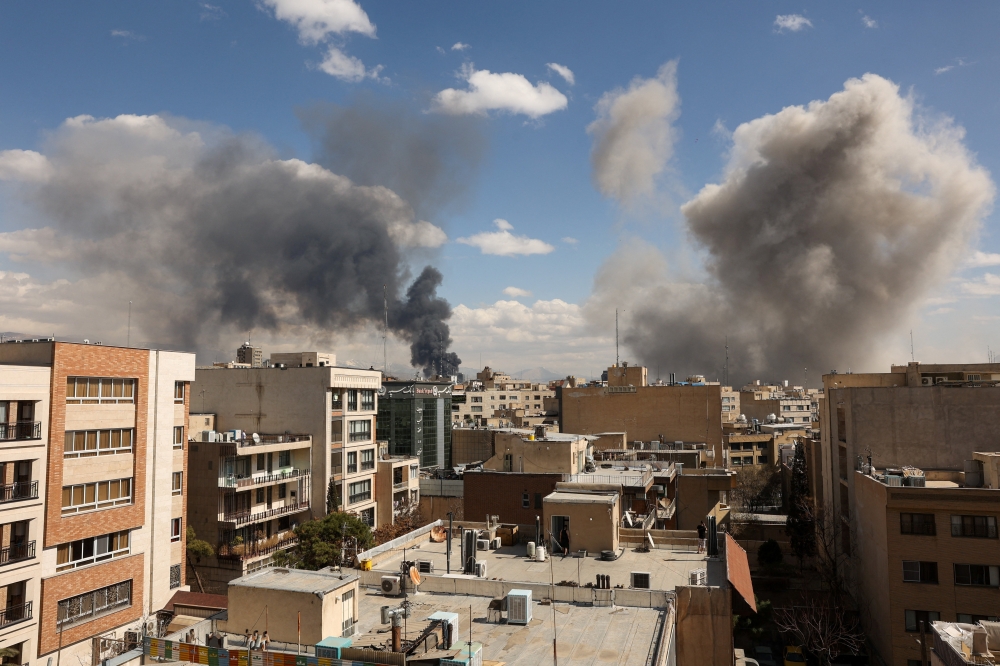
Smoke rises following an explosion, after Israel and the US launched strikes on Iran, in Tehran, Iran, March 1, 2026. — Majid Asgaripour/WANA (West Asia News Agency) pic via Reuters
Still, the Trump administration has proven highly effective at communicating through social media – even when the tone represents a marked departure from presidential norms, experts said. That’s particularly true when it comes to reaching Trump’s supporters.
Matthew Baum, a professor of global communications at Harvard University’s John F. Kennedy School of Government, said the potential problem for Trump was that he campaigned on a promise of American isolationism. As a result, it’s not clear that the message of military might through memes and online videos will be as effective as Trump’s previous use of social media to reach his Make America Great Again supporters.
“The problem here is that his base is not exactly entirely on board with the war in Iran. So it’s a difficult audience when it is usually the case that the MAGA base is ready to follow wherever he leads.” — Reuters


