


- Trump’s Iran campaign is fraught with risks, unknowns
- Trump says Iran’s Supreme Leader killed
- But analysts see “regime change” via air power as unlikely
- How war unfolds could help define Trump’s foreign policy legacy
- Intelligence reports contradict Trump’s claim of Iran missile threat to US
WASHINGTON, March 1 — With his large-scale attack on Iran, Donald Trump has seized a legacy-defining moment to demonstrate his readiness to exercise raw US military power. But in doing so, he is also taking the biggest foreign policy gamble of his presidency, one fraught with risks and unknowns.
Trump joined with Israel to plunge into war against Iran, and after a day of air strikes announced on Saturday that Supreme Leader Ayatollah Ali Khamenei had been killed, which would mark a major achievement for the operation but also leave unanswered questions about the future of the Islamic Republic.
Even as the crisis unfolded yesterday, Trump provided little explanation to the American public for what could become the biggest US military campaign since Afghanistan and Iraq.
He has pivoted away from a preference for swift, limited operations like last month’s lightning raid in Venezuela to what experts warn could be a more protracted conflict with Iran that risks escalating into a regional conflagration engulfing the oil-rich Middle East.
The president, who came to office last year promising to avoid “stupid wars,” has also set out a daunting objective of regime change in Tehran, pushing the idea that air strikes can incite a popular uprising to oust Iran’s rulers.
It is an outcome that outside air power has never directly achieved in other conflicts without the involvement of an armed force on the ground, and which most analysts doubt will succeed this time in Iran.
Though Khamenei’s death, if confirmed by Iran, would deal a major blow to the country he has led since 1989, it would not necessarily spell the end of the Iran’s entrenched clerical rule or the Revolutionary Guards’ sway over the population.
“Most Americans will wake up yesterday morning and wonder why we are at war with Iran, what is the goal, and why US bases in the Middle East are under attack,” said Daniel Shapiro, a former senior Pentagon official and US ambassador to Israel who is now at the Atlantic Council think-tank in Washington.
Trump’s fixation on Iran has emerged as the starkest example yet of how foreign policy, including his expanded use of military might, has topped his agenda in the first 13 months of his second term, often overshadowing domestic issues like the cost of living that public opinion polls show are much higher priorities for most Americans.
His own aides have been privately urging him for weeks to focus more on voters’ economic worries, highlighting the political dangers ahead of November’s midterm elections in which Trump’s Republican Party is at risk of losing one or both chambers of Congress.
The brief pre-dawn video that Trump posted on his Truth Social platform announcing what the Pentagon has dubbed “Operation Epic Fury” provided only broad reasons for going to war now with a country the US has jousted with for decades while averting all-out hostilities.
He insisted he would end what he said was Tehran’s ballistic missile threat — which most experts say does not pose a threat to the US — and give Iranians a chance to topple their rulers.
Trump said that to accomplish his goals US forces would lay waste to much of Iran’s military as well as deny it the ability to have a nuclear weapon. Iran denies that its nuclear programme has military aims.
This image grab taken from Iranian state television broadcasted on February 28, 2026, show what it says is the site of deadly US and Israeli strikes that hit a girls’ elementary school in Minab, in the southern Iranian province of Hormozgan near the strategic sea route of the Strait of Hormuz. — IRIB TV/AFP pic
Dashing hopes for diplomacy
Trump’s sudden resort to force, using huge US military assets built up in the region in recent weeks, appeared certain to close the door for now on diplomacy with Iran. Nuclear talks in Geneva on Thursday failed to achieve a breakthrough.
Some Trump aides have previously suggested that he might be able to bomb Tehran back to the table to force deep concessions.
Instead, Iran responded by launching missiles at Israel and several Gulf Arab oil-producing states that host American bases.
Trump’s focus in the video on the urgency of the threat posed by Iran’s ballistic and nuclear programmes had echoes of the case President George W. Bush made for war against Iraq in 2003, which later turned out to be based on faulty intelligence and false claims.
Trump’s assertion in Tuesday’s State of the Union address that Iran will soon have a missile that can hit the United States is not backed by US intelligence reports, according to sources familiar with the assessments, and experts have also cast doubt on his aides’ recent claims of Tehran’s ability to quickly advance its nuclear capabilities.
With yesterday’s strikes, Trump, who had originally threatened to strike Iran in January in support of street protesters facing a violent crackdown, also erased all doubt that part of what he seeks now is regime change in Tehran.
But analysts question whether Trump, who has ruled out deploying US troops on the ground, has a strategy that could unseat Iran’s longtime cleric-dominated government, which has proved resilient in the face of crippling sanctions and periodic mass protests.
The first wave of strikes mainly targeted Iranian leaders, including Khamenei, a staunch foe of the West who had ruled with an iron grip.
As reports of the supreme leader’s death spread, Trump posted that “Khamenei, one of the most evil people in History, is dead.” He credited intelligence and tracking systems for leading to the killing of Khamenei and other leaders who were with him, and urged other officials to accept immunity or face death.
There was no immediate confirmation from Tehran, where Iranian news agencies reported earlier that Khamenei was “steadfast and firm in commanding the field.”
The Israeli military listed at least seven senior officials and commanders it said had been killed.
Analysts warned that eliminating top leaders could have the unintended consequences of sowing chaos across a sprawling nation of 93 million or lead to a hardline military-run government that might be even more intransigent with the West and oppressive to its people, analysts said.
“He wants to change the government,” said Jon Alterman at the Center for Strategic and International Studies, a think-tank in Washington. “But it’s hard to change the government from the air. It’s hard to change the minds of Iranians through the air.”
Tyson Barker, a former senior US official who is now with the Atlantic Council, said Trump’s call for the Iranian people to rise up was also not likely to work.
“They’re really exposing these poor Iranian people by saying, ‘Stand up and overthrow your government. We got your back’,” Barker said.
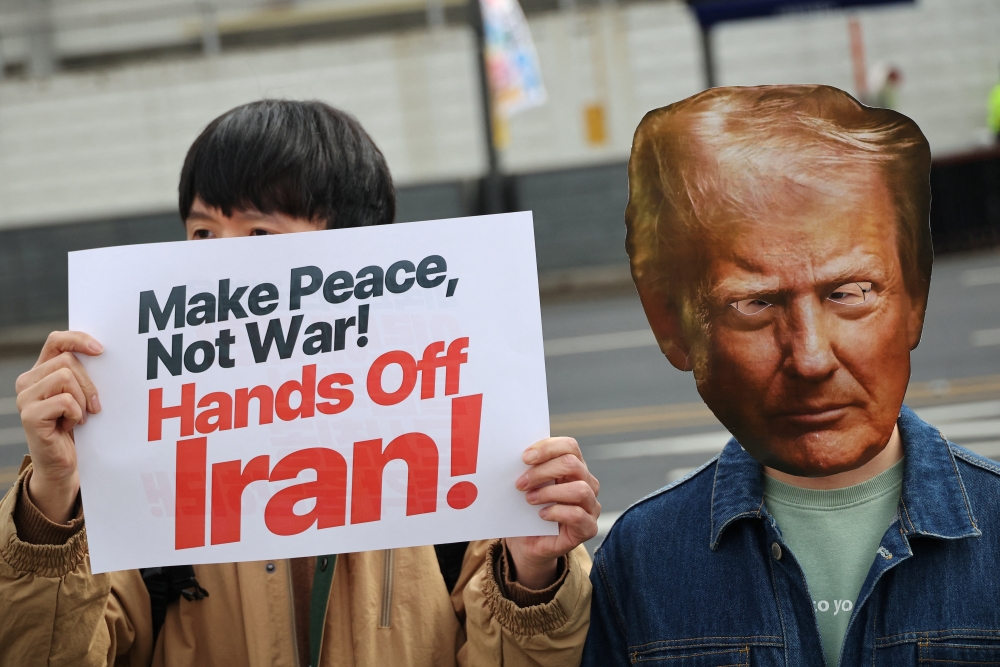
An activist wearing a cutout mask of US President Donald Trump attends a rally to condemn the joint US-Israel strikes on Iran, with others in front of the US embassy in Seoul March 1, 2026. — Reuters pic
Appetite for military risk
Trump’s appetite for foreign military operations has grown since the start of his second term.
He appears to have been emboldened by the US bombing of Iran’s main nuclear facilities in June and the in-and-out raid that captured Venezuelan President Nicolas Maduro in January and has given the US considerable sway over the OPEC country’s vast oil reserves.
Trump may have forced his own hand with Iran with his frequent threats of military action while building up a huge naval force that he could not sustain indefinitely in the region.
Analysts see Iran as a much tougher, better-armed foe than Venezuela, even though its air defences and missile capabilities were severely degraded in joint US-Israeli strikes in June.
But Mark Dubowitz, CEO of the Foundation for the Defence of Democracies, a nonprofit research institute considered pro-Israel and hawkish on Iran, said Tehran is in such a weakened state that it is worth Trump taking the risks to curb Tehran’s nuclear capabilities.
Whether or not the Iranian government falls, he said severely degrading Iran’s nuclear and missile programmes could be a victory for Trump. — Reuters


