


KUALA LUMPUR, May 16 — Stories about zombies continue to captivate audiences worldwide, and Malaysians are no exception.
Asia has developed a strong reputation for this subgenre, with some attributing its revitalisation to Yeon Sang-ho’s 2016 Train to Busan.
The action horror brought this South Korean outbreak cinema to a global audience, earning acclaim for its intense suspense, emotional storytelling, and human drama that surpassed 10 million viewers.
Together with its sequel Peninsula and animated prequel Seoul Station, these films cemented Yeon’s status as one of the leading names in zombie cinema.
Now, in 2026, the award-winning director returns with Colony, a brand-new take on the undead that is entirely separate from the Train to Busan universe.
Malaysia is set to become the first South-east Asian country to release Colony nationwide on May 22.
The next evolution of the K-zombie
Colony follows a group of survivors trapped inside a building after an unknown infection spreads rapidly.
Cut off from the outside world, they must fight to survive against infected individuals who continuously mutate into increasingly dangerous forms.
Director Yeon explained that the zombies in Colony differ from traditional portrayals, as they function through a collective consciousness rather than individual thought.
These beings evolve by receiving updates.
Totally lacking the mental barriers and imperfect communication inherent to humans, the collective itself exists as a single organism.
“The charismatic creatures we call zombies have served as symbols of the social anxieties and fears of their respective eras and evolved with the times,” he said.
“So when I set out to make Colony, I asked myself—what are the anxieties of the era we are living through now?
He said it’s an era in which information is exchanged at blinding speed, where as a result, individuality is gradually being displaced by a collective consciousness.
“Not only that, AI has begun to use this collective knowledge to mimic human intelligence.
“The zombies in Colony are a product of this new world,” he said in a statement.
Director Yeon Sang-ho, who helped propel the K-outbreak wave onto the global stage, returns with ‘Colony’, hoping audiences leave the cinema reflecting on what truly makes us human. — Picture courtesy of Showbox
Inside Yeon Sang-ho’s new nightmare
The project is led by actress Jun Ji-hyun, who returns to the big screen after 11 years to portray Professor Kwon Se-jeong.
“I’ve always been a true fan of Director Yeon Sang-ho,” she said.
“I was impressed by how many of his works featured strong female characters and had been rooting for his success.
“I was thinking of accepting the role even before receiving the script, and upon reading the clean and streamlined story struck me as incredibly appealing.”
The cast also includes Koo Kyo-hwan, Ji Chang-wook, and Shin Hyun-been.
Koo will portray Suh Young-chul, a multi-dimensional villain, and shared that he found the idea of constantly evolving infected beings particularly fascinating.
Ji takes on the role of Choi Hyun-seok, a character who experiences some of the film’s most dramatic emotional, physical, and personal transformations.
Having previously collaborated with Yeon on several projects, Shin, who plays Professor Gong Sul-hee, said: “Among Director Yeon’s works, this was my first experience working on a project that deals with situations unfolding within a new universe, so that made it interesting and refreshing.”
Additional cast members include Kim Shin-rock as Choi Hyun-hee and Go Soo as Han Kyu-seong, marking his first collaboration with both the director and the cast.
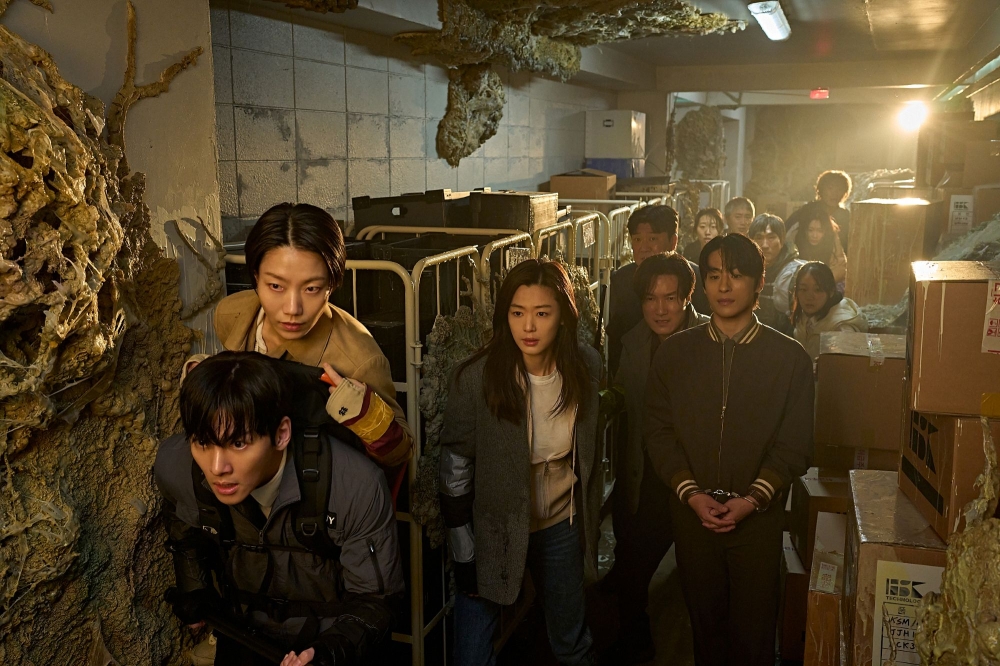
The cast of ‘Colony’, led by Jun Ji-hyun as Professor Kwon Se-jeong, marks the actress’ return to the big screen after more than a decade. — Picture courtesy of Showbox
A horror story about the AI era
Yeon said he hopes the fear portrayed in Colony reflects the anxieties people experience in everyday life.
“I made Colony with the hope that, amidst this horror, the audience might finish the film with the question, “What is it that makes humans human?” lingering in a corner of their minds.
“I hope the audience enjoys this film for its intuitive suspense and entertainment and that they can leave the theater in discussion about individuality, collectivity, and human identity,” he said.
The success of Train to Busan in Malaysia remains significant, with the film earning more than RM21 million at the local box office.
The phrase “nothing feels new anymore” could be said of the K-zombie genre, which has branched out into various subgenres.
Colony is set to demonstrate the evolution of the genre itself through the birth of a new species.
Colony will take stage next Friday across all Malaysian cinemas.